Bound for Glory – as featured in the CEO Magazine, October 2016

Bound for Glory – as featured in the CEO Magazine, October 2016

CEO Magazine Feature October 2016 | Bound for Glory

The CEO Magazine wrote a feature on the Perth Glory Football Club for their October 2016 edition and can be found on the link above.  The feature highlights the journey we have embarked on since I took on the CEO role at Perth Glory FC in August 2015 and the road we are embarking on ahead.

My accidental career path in sports

My accidental career path in sports

Over the years, I am regularly asked by bright eyed young people, how did you get into sports administration?  A career in sports has become a major career option progressively over the last fifteen years or so, but this career path wasn’t so prevalent when I graduated from university in 1991.

My first job in sports came in December 1993 in a totally unplanned and unexpected manner.  Prior to this and as a Bachelor of Business graduate with a major in Accountancy, in 1991, I embarked on my career in this field, firstly with a construction company and then a marketing / licensing business.

Around the same time, a close friend, Peter Abraam, invited me to join a sub-committee at the National Soccer League Club, South Melbourne Soccer Club.  Peter was a former player and now on the Board of Directors of this historic club and at the time, working as a Project Manager with the City of Melbourne.  South Melbourne Soccer Club was making a conscious effort to attract a younger profile onto their Board, which was at the time predominantly made up of first generation Greek businessmen.  Around this time the famous Hungarian, world renown ex Real Madrid player and coach Ferenc Puskas was coaching the Club and had coached the Club to its first national Championship in 1991 since 1984 with Ange Postecoglou as captain.

1990squad
The 1990/91 South Melbourne Squad with Ferenc Puskas as Coach, Ange Postecoglou, captain.  Also in the pic is President, George Vasilopoulos and Major Sponsor, Jack Dardalis from Marathon Foods, a generous benefactor and philanthropist

My initial involvement was as a Social Club sub-committee member where our charter was to raise much needed revenue and funds to support the Club’s quest in the National Soccer League.  Over the course of 1991 and 1992, we managed to initiate a number of successful activities and initiatives resulting in a secondment onto the Board of Directors in 1992.  I recall the Annual Presentation Night Balls we used to hold where I worked with fellow Directors such as Peter Abraam (ex head of the Victorian Major Events Corporation), Emmanuel Kotis, Jim Karakoussis, John Dimitropoulos and Peter Cartsidimas.  They were amazing nights well renowned within the South Melbourne Soccer Club and Greek communities of Melbourne held in the most prestigious functions rooms around Melbourne.

As a Board Member, I was able to bring to the table some strong administration skills and fresh new ideas and one of my first initiatives was to request a computer for the Club.  I still recall the looks on people’s faces when I made this request, explaining that I wanted to digitalise a lot of our processes.  Peter Abraam was delighted at the time as he had been asking the same for some time.  The main reason I had requested a computer is that I wanted to migrate the Club’s Membership database from a manual database to a computerised database.  Direct Mail under the old manual system was simply a nightmare. Quite quickly, once we acquired the computer, we managed to migrate the entire database onto a D-Base system at the time and we embarked on a data acquisition campaign so that we could begin a more aggressive membership program. Marketing material would be generated from the computer and Direct Mail became more prevalent. On the back of these campaigns, we had immediate impact.  Each week at the Board meeting, I would present hundreds of new membership applications with enclosed cheques and our Treasurer at the time was one happy gentleman.  It’s hard to imagine that the Club functioned with only a committee of management in place at the time who met for hours each Thursday evening which often went well into the morning hours.   Thankfully we had a great social club where we would gather to have dinner after we had watched the first team training and before the meetings would commence at 7:30pm.  The mixed grills prepared by Jimmy and Filio were something to look forward to.   Having met and befriended Cameron Schwab, then CEO of Richmond AFL team, their management team wasn’t very big at all either at the time in comparison.  Full time administrative set-ups and careers in sports administration in 1993 were not very prevalent.

After months of this activity and other influences the younger generation had on the Club via seats on the Board, the Board turned their focus to the possible requirement for a full-time General Manager, given that they could see the great outcomes generated from some organised activity.  The Club already had what they titled a ‘Marketing Manager’ in a gentleman I remain very good friends with today, Barry Horsfall.  The fact is, Barry was a self-funded employee as he was only earning a commission on new sponsorship and adverting deals he would generate. He did a great job in selling signage packages at the old home ground at Middle Park , which was demolished in 1994 to make way for the Australian Grand Prix track.  He would bring a cheque in for $X and he would immediately be remunerated with his pre-agreed commission of 30%, a formula that worked for some time.  This was a win-win and successful arrangement.

Scan 131810007 copy
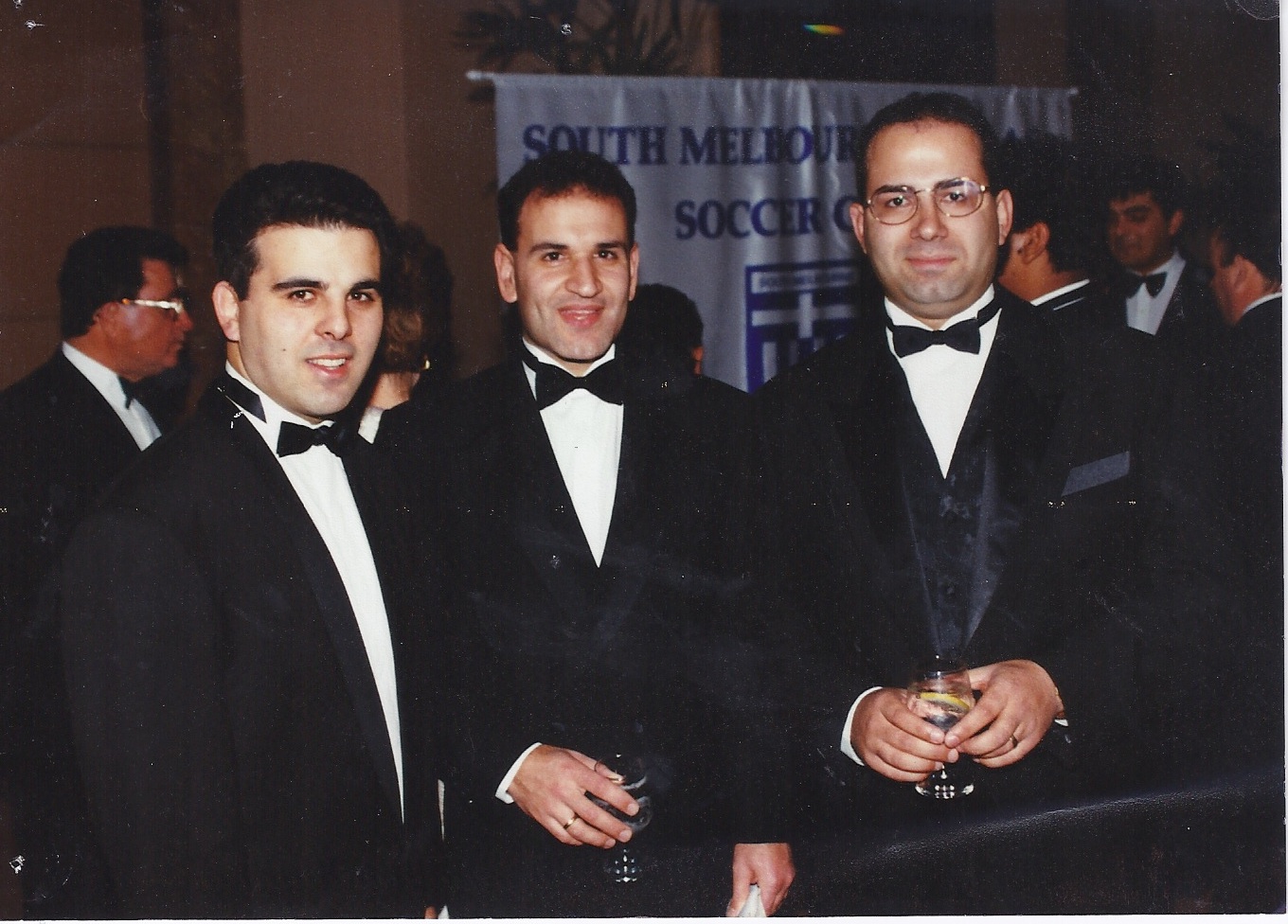
Fellow South Melbourne Soccer Club Directors, Peter Cartsidimas and Emmanuel Kotis around 1994 at the South Melbourne Soccer Club Annual Ball and Presentation night

The discussion of a full-time General Manager occurred whilst I was on vacation and on my return I received a phone call from fellow Director, John Dimitropoulos, then an associate solicitor with a former President’s and Chairman and co-founder of the NSL, The Late Sam Papasavas OAM, to advise that the Board was now actively looking for a full-time General Manager and that several people had nominated me as the ideal candidate.  The conversation went as follows:

“Pete, while you were away, we spoke at the Board Meeting about the need to appoint a full-time General Manager at the Club to oversee the day to day activities of the Club, some of us thought that you may be the ideal candidate.  If you are interested, this would require you to step off the board and become our inaugural General Manager.  This could change your life for ever.”

At the time, I was returning from vacation to accept a job with a national architectural firm as their State Accountant, a great job with an attractive package and consistent with my qualifications.  This and subsequent conversations with John, the President, George Vasilopoulos and fellow Director, Peter Abraam, threw a spanner in the works.  In speaking to my family, they thought it was a crazy idea.  I recall clearly my father asking me if I had lost my mind at the prospect of deviating from my chosen vocation to take up a post with the Club.

A career in sports in 1993, was not a well known or accepted career path, not the way it is today.  So much so, the most asked questions at barbecues was, “so what do you do in the off-season?”

Against all advice, my instincts told me otherwise and at the age of 25, I accepted to become the inaugural General Manager of the South Melbourne Soccer Club in December 1993 and commenced immediately.  I clearly recall waking up on the first day of my new job bouncing out of bed with a spring something I still do over 22 years later.  At such a young age, I had so much to learn and was wide-eyed and full of energy as General Manager of the biggest and most successful football club in Australia.

What I didn’t know at the time was that I had embarked on a career in sports something I look back on today.  This was the platform from which created my opportunities from thereon.  John Dimitropoulos was right, this decision was about to change my life forever in a way I couldn’t possibly imagine.

The beginnings

From my appointment as General Manager of South Melbourne Soccer Club, it was a baptism of fire.  So much to learn, however, it was great to have such good mentors and people that supported me. Peter Abraam in particular, would be on the phone multiple times during the day, steering, mentoring and inspiring me.  He still inspires me to this day.  We all became such close friends and every one at that time had an influence to my induction into the new role.  Many of these friendships remain in place even today, with both players and board members.

Our offices were underneath a grandstand at the stadium which accommodated a board room and a small office where I think I banged my head on the ceiling on several occasions.  It was in this office that one day in 1994 I received a phone call from the Head of Sport at Melbourne Grammar School who were searching for a Head Football Coach.  I recommended that they speak to our recently retired star player in Ange Postecoglou who was by this time Assistant Coach with the Club.  Ange took on the role and I remember him coming back and telling me it was fantastic and that the school was paying him more for a part-time role than what the club was to be Assistant Coach.  Ange delivered that message in a way only Ange can and we often joked about it.

The Australian Grand Prix arrives….

My initiation into the new role went into a spin.  Within weeks of commencing, we had received a phone call from the Premier’s office to arrange a meeting with the Club.  Upon attending the meeting, we were advised in absolute confidence that Victoria had almost acquired the Australian Grand Prix from Adelaide and that the race track would be in Albert Park Lake.  We then learned that as part of this grand plan, the pit straight was going to run right through our then home ground, Middle Park Stadium, home to the Club since 1960 and which we had just signed a 21 year lease for and had plans to re-develop with a new grand stand.  Our world had momentarily turned upside down.

Negotiations commenced immediately for appropriate compensation which resulted in the Club receiving a 21 year lease on Lakeside Oval (now known as Lakeside Stadium), once home to South Melbourne Football Club who was years earlier relocated to Sydney as the Sydney Swans.  The lease also incorporated a two-storey dwelling which housed a function centre upstairs and a social club and office space downstairs.  It was perfect!

With significant additional funding also provided by the government as part of the relocation package, we raised another $3.5M to build the purpose built football ground and after selling the naming rights, soon to be known as Bob Jane Stadium, which opened in December 2005.  It was a facility admired by all in football and this legacy remains today.

This process took a lot of hard and dedicated work and we were fortunate to have so many good people on our Board, lawyers such as Peter Mitrakas and John Dimitropoulos, Architects and Project Managers such as Peter Abraam, strong accountants such as Jim Karakoussis, a PR specialist in Jim Stiliadis and a politically savvy President in George Vasilopoulos at the time who forged a close relationship with the Premier Jeff Kennett, someone who also became our number one ticket holder in 1994.

File 30-12-2015, 2 01 07 PM
The President of South Melbourne at the time, George Vasilopoulos along with Chairman, Peter Mitrakas, presenting The Honourable Jeff Kennett with his Number 1 Ticket for the Club.  A dedicated supporter of the Club who would often attend games.
IMG_1567
Then Premier of Victoria, Jeff Kennett with our President, George Vasilopoulos, farewelling our old home ground at Middle Park in 1994 and announcing our new home ground development at Lakeside Oval.  Also in the picture was Managing Director of major sponsor at the time, Marathon Foods, Jack Dardalis
Last Game at Middle Park
Last Game at Middle Park in 1994 after 34 years of memories
796022-south-melbourne-v-melbourne-knights
An NSL game at new home, Bob Jane Stadium in December 1995 and the beginning of a new era

The Frank Arok era

The Club has entered a new era.  In July 1994, we had appointed the longest ever serving Socceroos Coach, Frank Arok as our coach after  lacklustre 1992/93 (after finishing first) and 1993/94 (after finishing second) NSL seasons where we would reach the finals and bomb out at the Preliminary Final.  There was a lot of fanfare about Frank’s arrival to South Melbourne having been a leading coach in Australian Football for decades.

Frank was crucial in the identification and recruitment of a raft of upcoming young talent which formed a nucleus for the successes we enjoyed long after Frank’s tenure.  Names like Billy Damianos, Tansel Baser, Steve Panopoulos, Con Anthopoulos, Con Blatsis to name a few.  Frank brought in a renewed belief in our junior development and plucked these players from our juniors to add to the big names like Paul Trimboli, Con Boutsianis, Ange Goutzioulis, Socceroo captain, Paul Wade, Mike Petersen, Steve Tasios, Francis Awaritife, Mehmet Durakovic to name a few….

File 20-12-2015, 5 37 35 PM
With Frank Arok at one of his recent visits to Australia along with friend Manny Gelagotis who Frank also coached at Gippsland Falcons

For 1994/95 season, under new coach Frank Arok and his recently retired South player, assistant coach – Ange Postecoglou, we played out of the old Olympic Park in Melbourne, as our new stadium at Lakeside Oval was being constructed, where we again bombed out at the Preliminary Final against Melbourne Knights with a memorable 3-goal performance by the V-Bomber, Mark Viduka.  I still remember the hurt on everyone’s faces after this game and there was even a little scuffle in the dressing rooms involving a couple of players that day which reinforced how much we were all hurting.  We had drawn the line in the sand – we wanted and demanded success.  This came several years later under a new coach, a young Ange Postecoglou, who picked up the baton from Frank and continued the journey in his own style. Ange was magnificent in instilling a sense of ambition and desire for success.

There were fond memories for the South Melbourne faithful of Olympic Park where we had won our latest Championship during the 1990/91 season in spectacular fashion against cross-town rivals Melbourne Knights in the most amazing penalty shoot-out one could ever imagine.

SM_v_Melb_Croatia_1991_NSL_GF
A packed Olympic Park for the 1990/91 NSL Grand Final between South Melbourne and Melbourne Knights

For the 1995/96 season, construction at our new stadium, Bob Jane Stadium, was completed and we played our first home game on Round 9 on 26 November 1995 against West Adelaide where we lost 3-2.  Danny Allsop scored along with Paul Trimboli.  The launch of Bob Jane Stadium was a big event and we packed the stadium.  The stadium was a major feature for the National Soccer League and the envy of all.  This was a pivotal time for the Club which continued to prosper with record membership, crowds and sponsorship coinciding with the opening of Bob Jane Stadium.

As we approached the end of the 1995/96 season, we saw the end of the Frank Arok era with three (3) games to spare as it became evident that the Club would miss out on the finals for the first time since 1989 and Assistant Coach, Ange Postecoglou was put in charge as interim coach for the last three (3) games winning all three (3) at which point the search for our new coach commenced immediately and I will touch upon in a later blog as to this journey and the emergence of Ange Postecoglou and the successes of that time in more detail.  Ange’s path to where he is today as Socceroos coach is a fascinating tale of passion, commitment, ambition and hard work –  I will share my insights into this wonderful story of Ange Postecoglou and his journey from retiring National Soccer League player through to back-to-back championship winning Head Coach of South Melbourne Soccer Club.

I do vividly recall prior to Frank’s removal as coach, after a game where we had lost to Marconi 3-0 at Marconi and a spray Ange gave the players on the long bus trip to the airport which has left its mark on me even today.   To be fair the players were misbehaving on the bus and carrying on somewhat without showing much hurt after such a drubbing at the hands of a rival and Ange felt it was time he reminded them in the strongest possible way about the badge that they represented and “how they had disgraced it that day”.  Little did I know at the time that the Socceroos Coach was born that day.  A word was not spoken amongst the travelling party for the remainder of the trip and even remember the players shuffling boarding passes so no one would sit next to Ange on the plane.  I don’t think Frank said a word for the entire trip slumped in a chair on the bus reflecting on the performance.  I also remember telling my President the following day of Ange’s exceptional display of leadership and how he would one day be our Head Coach.

After a whirlwind meeting at the Board meeting the following week, I recall having to call in Frank Arok the following day and arrange a meeting to advise him that the Board had unanimously decided to terminate his coaching tenure with the Club effective immediately.  There was immense and mounting pressure from sponsors, fans and members who would not put up with this mediocrity and the Board had to act swiftly.  Our club stakeholders demanded and expected success.

I couldn’t believe that I had just sacked the longest serving ex-Socceroos Coach and a man I admired and learned so much from.  He was a friend and still remains a friend to this day.  Many will tell you that Frank’s impact at the Club was effective and long lasting.  He began a process where he had set the foundations for our successes in the subsequent next few years.  Unfortunately the Board and Fans had run out of patience and as a Club we succumbed to the the need for immediate success.  Clubs like South Melbourne and its strong fan base, demanded success.

The emergence of Ange

Later that morning, I visited Ange Postecoglou at the bank on Clarendon Street, South Melbourne where he worked as a teller to firstly inform him of the decision to terminate Frank’s contract immediately and secondly that the Board had decided that he would take the reigns at interim coach for the remaining three games of the season.  Ange is not one to show too much emotion and in my experience with him, holds his cards close to his chest.  However, I saw the look in Ange’s eyes that day as I broke the news to him and I could see a person who understood the opportunity presented before him.  He sprung to action calling a meeting of the team the following day where he unveiled a carefully thought out plan for the remaining games.  He was determined to prove that he should be given the coaching job permanently.  Ange had enormous respect in the dressing rooms and the results showed this with three wins from three starts as we finished that season.

File 20-12-2015, 5 39 31 PM
Here with Ange Postecoglou in the dressing rooms at Etihad Stadium in 2013 following his last game as Coach of Melbourne Victory FC before taking the reigns as Coach of the Socceroos along with former fellow associates and directors of South Melbourne FC, George Livaditis and Jim Karakoussis wishing him the best with his new endeavours

On reflection

Since taking on the role as General Manager a few years earlier, the Club was achieving record membership, sponsorship, match day attendances and had built a formidable team which was in desperate need of a coach to help reach their potential.   I had developed skills by learning them on the job and in practise.

South Melbourne was widely acclaimed as the leading and most professional club in the National Soccer League.  So many worked tirelessly to reach this stage and as a young administrator learning the caper, I rarely was home before 8pm every night.  By 1997 we had an office which consisted of a General Manager, Sales & Marketing Manager, Office Manager, full-time Social Club Manager and a team of Chefs and casual staff.  It was only recently when some one tweeted a match day programme, “In Blue and White”, from the 1998/99 season where we had announced a major sponsor worth $1M over two (2) years which would have rivalled most of the AFL clubs at the time.  Having a look at the list of sponsors we had fantastic corporate support.

My entry into the world of sports administration was a whirl wind experience and by the end of the 1998/99 season where we had won Back to Back Championships under young Coach, Ange Postecoglou, I was beginning to contemplate where this journey would take me next.  I had completed six (6) wonderful years but I knew that if I would master this new career path, I needed to expand upon my experience maybe outside of football.

grand-final-win-1998-l

South Melbourne
24 Oct 1999: The South Melbourne Soccer team group during a team photograph at Bob Jane Stadium, Melbourne, Australia. Back Row (L to R) – George Vasilopoulos (President), Steve Iosifidis, Chris Jones, Vaughan Coveny, Con Blatsis, Nick Orlic, Milan Uduaracz, Robert Liparoti, George Goutzoulis. Middle Row (L to R) – John Anastasiades, Michael Curcija, Steve Panapoulos, Paul Trimboli, Ange Postecoglou (coach), Fausto Di Amicis, David Clarkson, Carl Halford, Goran Lozanovski. Front Row (L to R) – Adrian Cuzzupe, Jim Tskenis, Anthony Magnacca, Mustafa Mustafa, Tasos Psonis and Richie Alagich. Mandatory Credit: Tony Feder/ALLSPORT

It was in early 1999 that I had meet President, Ian Dicker and CEO, Michael Brown from Hawthorn Football Club via our mutual sponsors Puma.  My next opportunity was about to take shape, which I will also elaborate in a later blog.  As the Club was preparing for the inaugural FIFA World Club Championships scheduled for January 2000 to play against the likes of Vasco De Gama and Manchester United, I was beginning a new journey with a rival football code, the AFL, with the Hawthorn Football Club. The next 15 years sees me with the AFL for 8 years (3 with Hawthorn and 5 with North Melbourne), 7 years with Etihad Stadium and 18 months with Swimming Australia before accepting the CEO role at Perth Glory and relocating the family to Perth in August , 2015.

Scan 131810009 copy
Here I am at Hawthorn Football Club announcing a new sponsorship with the late John Ilhan from Crazy John’s in his first ever large scale sports sponsorship which I was proud to bring to the table.

During my six years at South Melbourne, I can now say, I was thrown in the deep end and in front of buses, however, I recall these days with fondness and have taken so many learnings from this experience and remain friends with so many wonderful people from that era. It was a ‘sink or swim’ environment and I am proud to say I survived.

South Melbourne still exists today and participates in the NPL Victoria based at Lakeside Stadium which has gone through another major transformation and most likely the best facility in the National Premier League.

I am proud to remain a life member of the Club today and I am grateful for the opportunity given to me back in 1993 to take on the reigns as General Manager / CEO which has paved my career to where it is today.  So many fond memories and close bonds that I will never forget.

Fifteen years later, in my current role as CEO of Perth Glory Football Club, participating in the Hyundai A-League, I draw upon my experiences and learnings from South Melbourne often and I have been overwhelmed by the support I have received since returning to the game I love, all because I was once involved with South Melbourne which has helped get instant acceptance and respect.

Peter Filopoulos


They know we are coming!

They know we are coming!

With all the hysteria over the last fortnight since Rebecca Wilson’s expose on the 198 banned A-League fans, I think what has largely been overlooked is that, after many decades of football playing second and third fiddle to other codes, football has arrived bigger and stronger than ever.  Since this latest attack on football, I have been overwhelmed with the response from the football community which has come together and galvanised stronger than ever.  Amongst the adversity, it’s time we capitalised on this passion and united front and turned it into our advantage.

Having only returned to football professionally in August this year after 15 years working within the AFL, a world-class stadium in Etihad Stadium and more recently Swimming Australia, I can assure you that something I saw very evident in the boardrooms of rival football codes and other sporting clubs and associations, was a growing acknowledgment of the significant growth of football in the grassroots and the emergence of the sport in terms of our national teams and the incredible fan experience at many of our Hyundai A-League matches.  They know we are coming and they are concerned.  One thing for certain is that football is now a real threat!

It is therefore no coincidence that Rebecca Wilson’s article and Alan Jones’s outburst on radio comes at a time when Roy Morgan released data clearly showing that football is the number one sport amongst kids aged 6-13, in fact 50% of all kids play football.  More alarming is the fact that more girls are now playing football than netball…..

Roy Morgan Data.jpg

How exactly Rebecca Wilson came to accessing such confidential information of the 198 fans that have been banned from Hyundai A-League matches around Australia remains a mystery, however, what hasn’t gone unnoticed is that both Rebecca Wilson (through her partner) and Alan Jones have links to the Sydney Cricket Ground Trust which manage Allianz Stadium and would have access to this information.  We need to identify where this leak has come from and more importantly, the motivation behind this leak.

Whether you think I’m a conspiracy theorist or not, to me it’s paramount to identify and expose this leak as there is an underbelly of ‘haters’ trying to cause damage to our sport.  Rival football codes are powerful in Australia with strong concrete links into media, government and key influencers.  I know too well how much influence AFL and NRL have in these mediums and they will not stand by to watch football take over and will do whatever they can to control the share of voice.

Whilst I can understand why the fans are upset, they feel abandoned and alone in this attack and key figure heads missed the opportunity to strongly defend them publicly, we must not forget that amongst the 198 banned fans, there are many bans that are very much justified.  In Perth last year, a young 10 year old boy had his leg burned by a flare lit by one of these now banned fans.

Notwithstanding this, I also think that we need to ensure we exercise care when we are banning alleged offenders.  Is the evidence compelling, is there an appeals process in instances where people have been wrongly accused, how are we advising the affected fans and how are we presenting the evidence against them?  Are our stadiums well equipped and trained to deal with a different type of fan, one that is more passionate and wants to participate in authentic fan engagement within their active fan areas?

What I think the fans wanted to hear from FFA was:

  • We support the fans and enjoy the colour and atmosphere they bring to the games – The Fans are are our biggest asset!
  • We condemn the media who have gone down the path of attacking the game and the fans and for leaking confidential personal information
  • We stand by and reinforce that the we are committed to providing a safe and secure environment for all fans at our venues
  • We will review the banning process to ensure that there are no flaws in the system
  • We will look at introducing an appeals process to ensure that fans are not being wrongly implicated as part of the review
  • Once we review and refine the banning process we will share it with all football stakeholders including fans so that we are all well aware of the parameters of the process
  • In the meantime, any fans who feel that they have a case that needs to be reviewed, we invite them to come forward so we can review their ban

Having said this, I would have liked to have seen the fans not boycotting our A-League matches over the weekend so as not to give our detractors any more reason to judge the sport.  We have given them more reason to talk about our sport adversely.  We have and continue to give the mainstream media too many free kicks and own goals as a collective.  It’s time to stop pressing the self-destruct button.

At Perth Glory Football Club, we have 21 fans who have been banned for a variety of reasons and we are currently dealing with three (3) cases which are being reviewed and have been submitted to FFA for consideration.  We have also made it known that if fans feel that their cases need to be reviewed that they come forward stating their case and the circumstances around their request to review their ban and which we will take up with FFA on a case by case basis.

What have we learned from the past?

We must not forget where we have come from.  Whilst kudos and due recognition must be given to the past for carrying the torch for soccer for so long with limited resources, we must not forget the plight the game faced in the early 2000’s where it was clearly at the crossroads.  However, I also don’t think we have succeeded in bringing the “old” along on a journey as the game prospers, although the FFA Cup has been an outstanding success connecting grassroots football with the Hyundai A-League.

When I left my post as CEO of South Melbourne in 1999 after six (6) and on the back of some extraordinary on-field and off-field successes as a Club in the National Soccer League, I left a sport where:

  • The National Soccer League was not very marketable and was deteriorating at a rapid pace
  • There was significant political infighting at the Soccer Australia boardroom lead by a directionless Board
  • Soccer Australia was virtually broke and struggled to fund our national teams and NSL adequately
  • Many of the NSL Clubs were in financial strife and suffering from a lack of direction from the governing body and within
  • Collective bargaining issues with the PFA plagued the sport
  • Channel 7 bought the television rights only to warehouse them with no intention of televising our game
  • The NSL was not broadcast on television other than limited  coverage on SBS

This came at a time when Australia was producing some extraordinary football talent.  Who can forget the emergence of Mark Viduka who at age 19, won the Player of the Year, Under 21 Player of the Year and Top Goal scorer all in the same year.  Whilst it came with great personal disappointment for my Club, South Melbourne, where I was a Life Member,  it came as no surprise to me when the NSL was disbanded in 2004.

However, not all was bleak, the emergence of Perth Glory Football Club in 1996 was spectacular with regularly sold out crowds of between 13,000 – 18,000 each week at Perth Oval.  Clubs like my old Club South Melbourne built a purpose built rectangular stadium as their home at the old Lakeside Oval (once home to South Melbourne Football Club now known as Sydney Swans) and regularly averaged crowds of 8,000 – 9,000 at their home games.  Current Socceroo Coach, Ange Postecoglou was given his first chance to coach the historic Club and which he did very successfully adding two championships as coach to his two championships as a player and leading the Club in the inaugural FIFA World Club Championship and drawn against Clubs such as Manchester United and Vasco Da Gama.  New clubs like Collingwood Warriors, Carlton FC and Northern Spirit came and went, invariably targeting the ‘mainstream’ football fans with no ethnic base.  Carlton FC provided young guns Mark Bresciano, Vince Grella and Josh Kennedy their entree into spectacular football careers.  Sydney United and Melbourne Knights continued to be a football development factory for Australian Football and what talent they produced, names like, Tony Popovic, Ned Zelic,  David Zdrilic,  Mark Rudan, Jacob Burns, Zeljko Kalac, Mark Bosnich, Ante Milicic, Mark Viduka, Josip Skoko and the list goes on.

In 1999, as a young aspiring sports administrator, I decided to pursue opportunities outside of football to master my accidental career path.  My opportunity was provided when I was offered a senior marketing / commercial role at Hawthorn Football Club which springboard my career with senior roles within the AFL, Etihad Stadium and Swimming Australia.

My personal experience with football was one of contrast.  Having two (2) children aged 19 and 8, I have experienced two very different environments with football at the grassroots.  When I took my eldest son George to play Under 8s with South Melbourne in 2004, I recall that the club had one team per age group and we would play other clubs each week who also had one team per age group.  Some weeks we would be short of players and other weeks the other clubs would be short of players and we would swap players to make up the numbers.  Fast forward nine (9) years later in 2013 when I took my youngest son, Jonathan, to a local community Club called Ashburton United in the south eastern suburbs of Melbourne – here we find that there are up to eight (8) teams per age group at a Club with over 1,200 juniors.  Extraordinary.  They had access to five (5) reserves around Ashburton, including some underutilised AFL reserves.  The names of juniors were no longer ending with ‘os or ‘ic or ‘ski, they were the Smiths’ and Jones’.  The families were coming from traditional “Auskick” environments to “Football”.

In 2015, Auskick saw a decline in numbers of upto 15% in some regions whilst football continues to swell in numbers.  One of my jibes around town which is not appreciated by some quarters is that whilst cricket grounds and AFL grounds erect Auction Boards to advertise for “Players Wanted”, football just keeps on taking over their grounds to accommodate the soaring demand.  This is another challenge we need to keep working on as our participation base continues to soar, working with local, state and federal governments to ensure we are getting access to our fair share of facilities and funding.  In Perth, we are excited to be working on a Home of Football collaboratively with Football West and the State Government which is working on providing the state with a true “Home of Football” to house our elite and community needs. An exciting project indeed and well deserved for the 45,000 participants of football in WA.

Where are we now and where are we heading?

After 15 years away from the sport, I got my opportunity to return earlier this year by taking up the post as CEO at Perth Glory Football Club, following the controversial salary cap scandal of the 2014/15 Hyundai A-League Season.  Four months in, I am relishing the opportunity and challenges that come with it as we enter a new phase of consolidation and rebuild.

th8B7VK0J3.jpg

There is no doubt the Hyundai A-League is a lot more marketable. Fox Sports presents the sport so well in their coverage of all games each week.  Our Socceroos are regularly qualifying for the World Cup and in 2015 and we won the AFC Asian Cup on home soil.  The interest in football is increasing amongst the community, government and corporate Australia and the platform has been set over the last ten (10) years from which the game can now propel itself from.  Not for a minute should anyone underestimate the ‘heavy lifting’ that has been performed by the Lowy administration since taking over.

Our ‘shop front’ window is looking better than ever despite recent issues.  However, behind the scenes we have invariably many similar issues and which need to be resolved if we are to continue to improve and develop as a sport and league.

  • Club owners are bleeding money.  In fact A-League clubs lost a combined $17M last Financial Year.  The financial stability of A-League Clubs must become a priority as owner’s writing off losses is no longer sustainable
  • Our attendances fluctuate and the league needs more aggressive marketing – in fact I don’t believe we have a dedicated Chief Marketing Officer at FFA to drive Marketing strategies.
  • I stand to be corrected on this number, however, I once saw a statistic which indicated that 75% of AFL participants are linked to an AFL Club whereas only 35-40% of Football participants support an A-League Club (since writing this blog I have been informed that this number is closer to 19%)
  • Our broadcast revenue is not enough to enable us to build upon the sport top down and bottom up – we need to significantly improve our broadcast deal and introduce other commercialisation strategies to increase revenues.  To achieve this we need to market the game better to increase attendances and eyeballs
  • We lack a strong vision for the league.  What’s our vision for 2020, 2030 and beyond.  What strategies are we implementing to achieve this vision?  What are the key strategic pillars which will be the pathway to our vision?
  • The funding model of our national teams and the A-League needs review – are we allocating the funds in proportion to our key priorities and is there a disparity?  The broadcast deal at present is $160M over four (4) years, primarily for the A-League, however, only $100M ends up with the A-League Clubs to underpin the $2.5M salary cap per club
  • The quality of the league is heavily dependant on the quality of the marquee players – if that’s the case, what’s the overarching strategy to ensure we attract “MLS” type marquees?  A good example of this is, Tim Cahill.  We are in desperate need of such an Australian icon to to play in the A-League as opposed to China, noting, the economics need to work for both.  Our football fans are spoilt for choice when it comes to viewing football and in order to increase the interest, we need to attract big, high profile names to the A-League
  • The relationship between the PFA and Football has not improved as was evident in the recent collective bargaining agreement stand-off.  Clearly there is a divide there that needs to be mended and the PFA need to also take responsibility for this
  • How are we capitalising on Asia?  The EPL Clubs are increasingly entering Asia as they see the growth opportunities.  We need to understand how we can do the same and this needs to be considered carefully
  • Is our football pyramid as it should be?  The FFA Cup has been overwhelmingly successful, so what have we learned from it?  See below for my view.

Hyundai A-League Strategy and Vision

What plagues the Hyundai A-League in my opinion is the absence of a  strong and clear strategy for the competition.  What’s our vision for the A-League in the next 4 years, what do we want the competition to look like and more importantly what are the key pillars to the strategy that will help achieve this vision.  As a new CEO of a Club in the Hyundai A-League and regularly speaking about the game with sponsors, government, fans and the broader community, I am not able to speak with clarity about our vision and strategy as a competition.  As a Club, we are embarking on our own four (4) year strategy at present and this will be made much easier if we were clear on the A-League strategy and vision.  The FFA are working on a strategy at the moment, however, a concern I have raised with them is that the A-League is only a component of the overall strategy.  It’s now time to expand on this strategy to develop a vision for the league and this process needs to involve all stakeholders – owners, CEOs, FFA Board and management, players, fans, broadcasters, sponsors….

This strategy and vision needs to be developed by all key stakeholders as a one united front.  The time to develop this vision and strategy for the Hyundai A-League is NOW.  The strategy will encompass all facets of the league, expansion, financial sustainability, commercialisation, corporate governance, broadcast, digital, marketing, marquee players, venues, fan engagement etc.

Controversially, what also needs to be considered in my opinion is a national second division so we can begin developing the next tier of playing talent as part of our talent development pathways as well as building the next layer of national football brands.  This is by no way an endorsement of promotion relegation as I don’t believe our model can sustain this at the moment.  At present, if we as a Club wanted to identify talent in the National Premier League, which is a state by state type tiered football league, we would need to troll through over 200 clubs and around 4,000 players with our best talent spread over too many clubs.  In my opinion, we are not seeing the best of the next tier of talent.  A national second division (without promotion / relegation to the A-League for now) would capture our best talent across ten (10) clubs providing a national stage for them to shine and be indentified.  This view is further reinforced by the current situation where very only few players are rising from the NPL to the A-League as the gap is too big.  Capturing the best 200 next tier players in one national second division of ten (10) Clubs will help nurture and develop our best talent as well as build the next layer of football brands.

Recently at Perth Glory we trialled a number of NPL products from all over Australia who are not too far from A-League but not too close either, however, this great young talent would benefit from a second division national tier which will accelerate their transition into the top league by playing in a stronger competition.   A close review of the statistics of players transitioning from NPL to A-League will be alarming and needs to be reviewed and considered in the whole of football strategy.  Of course this comes with financial challenges, however, if we don’t have aspirational elements to our strategy, we are not trying hard enough.

As we enter the most pivotal time that has confronted our sport in the last decade, the decisions we make in the coming months will determine where our sport will be in the next 5, 10 and 20 years.  As a new FFA Chairman settles into the role and inducts his relatively new Board, we look forward to participating in whatever needs to be done to find our path to sustainable success as a sport and competition.

Without an aspirational strategy and vision we will not capitalise on the explosion of football at the grassroots.

Exciting times ahead.

We are Football. #beautifulgame

Peter Filopoulos – @peterfilopoulos | peterfilopoulos.com