A reflection on our first 12-months of “The Perth Glory Way”

A reflection on our first 12-months of “The Perth Glory Way”

Peter Filopoulos, CEO Perth Glory and John Marinopoulos, Partner, PwC Australia

“You have to learn the rules of the game. And then you have to play better than anyone else.”
– Albert Einstein

It’s been 12-months since Perth Glory unveiled its ambitious and bold four-year  strategy on 24 February, 2016 called “The Perth Glory Way”.

Perth Glory and the team at the then Strategic Intelligence Group and now PwC, wrote the strategy after wide consultation with all quarters of the Perth Glory Football Club, using Einstein’s maxim above, “learn what is the pathway to success and then play better than anyone else”.

Some of the key measures in the strategy are already coming to fruition. Others will take the full four years to finalise. That was always the plan. After all, Rome wasn’t built in a day. The near term measures that are vital to ensuring The Perth Glory Way started on the right foot:

  • For our players and coaches, we will be where innovative, exciting and brilliant football are the core to delivering success at all levels
  • Perth Glory will be a club for all Western Australians in which they can be proud. Always
  • 10,000 Members and 12,500 average attendances by 2018
  • Ensure that The Perth Glory Way and the values Perth Glory espouses (Loyalty, Passion, Respect, Innovation, Excellence, Trust) is incorporated in all interviews, media engagements, public relations and social media.

The Club has progressed in leaps and bounds since 2015 and its people are now focused and united under the one banner of “The Perth Glory Way”.  Having a clear strategy and direction has definitely provided a good framework for everyone at the club.

FOOTBALL

Examining some of these measures shows how Perth Glory has progressed. Take the football performance goal “where innovative, exciting and brilliant football are the core to delivering success.”

Under Kenny Lowe’s stewardship (from season 2014/15), the team has seen its best win-draw-loss ratio (34W – 19D – 21L) in Hyundai A-League history.

In fact, since unveiling The Perth Glory Way on 24 February, 2016, our team has earned the second highest number of regular season points and scored the most goals in the A-League, crossing both 2015/16 and 2016/17 A-League seasons.

After finishing 5th in 2015/16 and qualifying for finals, as it stands at Round 20 of the 2016/17 Hyundai A-League season, the club finds itself in fifth (5th) position and only two (2) points from 3rd position.  Perth Glory have not been lower than 6th for the whole season.

The remaining seven (7) rounds provides the club with an opportunity to not only secure 3rd or 4th spot which will see us secure a home final, but also a possible Asian Champions League spot.

The club has scored the third highest number of goals in the A-League this season with 38 goals through the exciting attacking options of Andy Keogh, Adam Taggart, Diego Castro and Chris Harold.  No doubt we need to tighten up at the back where we have been conceding more goals than we would have hoped if we are to realise our ambition of 3rd spot, but then again, as Kenny says, if we keep on scoring more goals than we concede, then we get the same result.

Castro is peaking at the right time, Taggart is scoring goals consistently, Harold is second in goal assists in the league and Liam Reddy has been in superb form in goal.

Perth Glory has focused strongly on growing and developing as a Club.

The goal of “Perth Glory will be a club for all Western Australians in which they can be proud, always” is part of the reason why Perth Glory have brought in so many Western Australians of absolute merit into the team. The sight of a full “Shed” at the Northern end of nib Stadium shows the pride is back.

Our social hashtags of #GLORYISOURS #WAPRIDE has resonated with the Perth Glory faithful who have so much hope for their club and team.

 MEMBERSHIP, ATTENDANCES AND TV

What has all of this meant for the crowds? One of the goals was for “10,000 Members and 12,500 average attendances by 2018.”

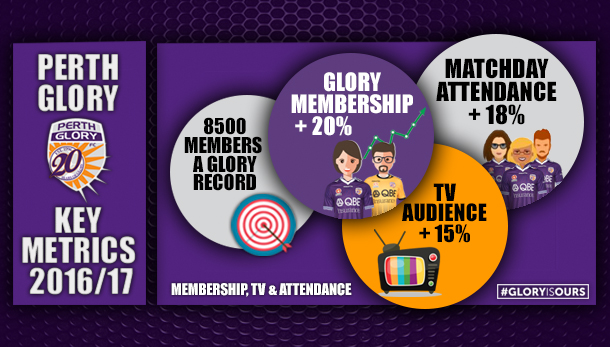
Membership continues to soar at Perth Glory Football Club.  The fans and members have responded to the club’s push for membership and we are grateful for this.  We have now achieved a consecutive club membership record with over 8,500 Members, a 20% increase on the previous season and a 36% increase since 2014/15 and almost double in five (5) years (since 2012/13) as we turn our sights to 10,000 from next season.

Since unveiling The Perth Glory Way, our attendances have been very strong for which we thank our fans and members.

In analysing the numbers, we have the highest percentage change in average attendances in the A-League post the Perth Glory Way being unveiled on 24 February, 2016.  Our average attendances have increased by 56% since that time.

img_0342

Perth Glory’s average attendance is now 10,700, up from 6,874 in the first part of the 2015/16 season following the unfortunate salary cap saga which plagued the club during the 2014/15 season.  Overall, this year’s crowd average of 10,700 represents an 18% increase on the previous full 2015/16 season.

Our attendance average for 2016/17 is now the highest for the Club in its 12 season A-League history.  We have some big games ahead of us this season and we hope to further improve this average attendance number at home.

Our television audiences have also increased by 15% with average viewership on FoxSports of more than 60,000 viewers nationally.

W-LEAGUE TEAM

Our women’s team made us proud this year.  Led by flamboyant ex-player and now coach Bobby Despotovski as well as our world-class captain Samantha Kerr, they qualified for their second W-League Grand Final in three (3) seasons.  A magnificent achievement in itself.

Unfortunately, we didn’t manage to win against Melbourne City on the day in front of a home crowd of over 4,500 people, however, we have a great platform to work from.

The attendance of 4,500 and viewership total of 165,000 on Fox Sports and ABC was a W-League record.

I caught up with the women after the game over a few drinks and they were super excited and can’t wait to get back for next season to go all the way.  A terrific bunch of ladies who we are extremely proud of.

img_0346

img_0299
The Grand Final W-League Shirt signed by our Perth Glory Women
img_0282
After qualifying for the Grand Final with a stunning 5-1 victory over Sydney FC, from L-R, myself, Niki Stanton, Tony Sage, Vanessa Di Bernardo and Bobby Despotovski

ADMINISTRATION

A consistent administration helps make progress as a club and I am pleased that we have a stable, dedicated and extremely hardworking team who embody the lofty aspirations of the Perth Glory Way.

As I stated in our message to the Members, our achievements to date is a testament to everyone at the club, on and off the pitch that the Glory Days are back as we strive to hit 10,000 Members and beyond and 12,500 average crowds as our part of our four-year strategic plan.

I work with some amazing people day-to-day and that’s what makes Perth Glory Football Club a special place to work.

In November, 2016, we moved into our new administration and retail headquarters sharing facilities with Western Force and WA Rugby.  It is situated near the training base and we are essentially now within 20-30 metres of each other (football and administration).

img_0332
Our team store at the new Perth Glory HQ
Over the last 18-months we have also been working on a business case which has been submitted to state government for a new $40M state football centre.  In January, 2017, Premier Colin Barnett, announced a pledge by the Liberal Government of $37M towards the state football centre.  This facility will provide for all the needs of Perth Glory Football Club and Football West with four (4) pitches, floodlights, grandstand for 2,000 and overall capacity of 4,000 and training, high performance and administration facilities.

1484896897687

Special mention must also be made about our Chairman and owner, Tony and wife Lucy, who make a lot of sacrifices to make it all possible.  Their support is essential and very much appreciated.

OUR HISTORY

This season we have also celebrated our 20th season of national competition and it’s been great to be able to pay tribute to our history.

At our Round 1 fixture this season, we managed to gather a number of players and officials from the Club’s inaugural season – 1996/1997 –  to celebrate the occasion.

The occasion was one to celebrate, after all, Perth Glory’s spectacular emergence in 1996 was critical to changing the football landscape in Australia for ever.  In fact, the new A-League was modelled on clubs like Perth Glory, something that is often forgotten and something we as a club should always be proud of.  We were the “game changers” and our forefathers should also be acknowledged for this.

We have also had visits from NSL coaches, Bernd Stange and Mitch d’Avray during the season.  A true feeling of nostalgia at the club and a growing appetite to bring back some success and trophies.

It was also great to gather some of our forefathers together, Nick Tana and Paul Afkos (co-founders of the club) along with current owner and Chairman, Tony Sage.

Too often it is forgotten how Perth Glory spectacularly emerged in 1996 under the National Soccer League and the significant influence they had with re-landscaping football in Australia with the creation of the new A-League.

It was opportune to honour people like Nick Tana and Paul Afkos who founded the club with such boldness and for Tony Sage for carrying the torch and keeping the dream alive.

img_0397
A rare shot at the Round 1, 2016/17 20th season celebration match. They call this the Perth Glory “money shot” as it’s rare to see all these people together, from L-R, Roger Lefort (original GM), Paul Afkos (Co-founder), Nick Tana (Co-founder), myself and current owner, Tony Sage.  It was a great day thoroughly enjoyed by all.
img_0379
At Round 1, 2016/17, celebrating our 20th season with the inaugural team, coaches and officials.  From L-R, myself, Mickey Brennan (Assistant Coach), Tommy Maras (Goalkeeper), Vladimir Beretovac, Bobby Despotovski, Doug Ithier, Vas Kalogeracos, Peter Vukmirovic, Dale Wingell, Mark Wingell, Barry Tate (Kit Man), Alan Mackenzie, Gary Marocchi (Coach), Roger Lefort (General Manager), Robert Zabica (Goalkeeper), Nick Tana (co-founder), Tony Sage (current owner), Paul Afkos (co-founder)
img_0552
From L-R, Tom Mackay (author), Paul Afkos, Tony Sage, myself, Bernd Stange, Roger Lefort and Gary Marocchi

OUR GLOBAL REACH

It was a delight to announce that Perth Glory will play in an international friendly against English Premier League Giants, Chelsea FC at the new world-class Perth Stadium in July / August, 2018.

This has been a terrific initiative by the WA State Government, Tourism WA and Venues Live and look very much forward to the opportunity.

Everyone at Perth Glory, and indeed all of WA, are looking very much forward to one of the world’s biggest football clubs playing international football in our magnificent state of WA and at the state of the art, Perth Stadium.  It would be wonderful to see 50,000 plus fans fill the Perth Stadium for an international football game involving Perth Glory.

Over the last 12-months we have also participated in tournaments in Asia for our young teams with tournaments in Japan and Malaysia.  Our pre-season tour was conducted in the Philippines.

The club is still looking for a suitable partner to take one of our Hyundai A-League games to Asia on an annual basis.  We are continuing along this ambition and having meaningful and regular dialogue with potential Asian partners.

img_0053
Acknowledging the Premier, Colin Barnett’s announcement that Chelsea is coming to Perth to play Perth Glory FC in July / August, 2018

Even above all of the metrics are the clear values that the club now espouses (Loyalty, Passion, Respect, Innovation, Excellence, Trust) in all media and interactions. Perth Glory was recently seen as the most trust worthy sports brand in WA social media.  “Excellence is not an exception, it’s a prevailing attitude”.

The first 12-months of the Perth Glory Way lifespan has been a great start, but there is much more to come. Perth Glory have to keep the successful game plan going. The administration has to ensure that it keeps striving to increase membership, stakeholder relations, and be profitable in its own right. Oprah Winfrey said:

“Doing the best at this moment puts you in the best place for the next moment.” – Oprah Winfrey

We must always excel, as we have in the last 12-months.

So thanks to a long list of the Perth Glory family that have started this renewed journey to continued success for all of WA. To Tony Sage, Kenny Lowe, our wonderful players, staff, government, sponsors, our phenomenal fans and members, and all the stakeholders we thank you.

Here’s looking forward to the next 12 months of The Perth Glory Way and to our continued successes. #GloryIsOurs

#GLORYISOURS #WAPRIDE

“Sage still sees power in Glory”

“Sage still sees power in Glory”

RAY GATT

SOCCER

As he walks through the foyer of the Crown Metropole in Melbourne , there is a noticeable spring in the step of Tony Sage.

Sinking into the lounge, there is also a large smile on his face. The Perth Glory owner and West Australian mining magnate is in a good space. It’s a long way from the heartbreak of almost 18 months ago when Glory were stripped of points and kicked out of the finals over what Football Federation Australia said was systematic rorting of the salary cap. Everyone was on Sage’s back, from FFA to the fans to the media.

He has always had a love-hate relationship with the fans, but the calls for him to get out of football and sell the club had reached a crescendo. While he told The Weekend Australian at the time that he had to take the blame for not keeping a better eye on how the club was being run, it wasn’t enough to appease the supporters.

The salary cap issue also came at a time when Sage, who has poured his heart and soul as well as an estimated $20 million into the club, was in the middle of a tough period business-wise with the mining industry suffering a downturn. “It’s been a tough two years, football and business-wise , that’s for sure,” Sage says. “It was a bit scary, to be honest, after the salary cap issue, especially with the fans. But things are a lot better now. The club is on a far better footing in most respects now and my business situation has just about turned around. If you go around and ask the fans now, I’d say 95 per cent support me.”

On the back of a new management team led by respected administrator Peter Filopoulos and the astute coaching of Kenny Lowe, Glory got their house in order and won back a lot of respect last season in finishing fifth — just six points off the Premiers Plate — before falling at the first finals hurdle. Having made the finals in four of the past six seasons, including a controversial grand final loss to Brisbane Roar in 2012, Sage is desperate for his club to win an A-League title.

He admits it is what drives him and why there is no way he will sell the club. Sage revealed he has had offers from China over the past 18 months, but is holding off.

“I am very committed to (owning ) the club,” Sage says. “I have always said I wouldn’t consider selling until I won a title.

“There have been offers from the Chinese. I said no. I have just about survived the two worst years of my life, so I’ll keep supporting the club as much as I can and until we win an A-League championship.”

There is also the matter of trying to get something back on his massive financial investment. Sage said he was hopeful Glory could go close to breaking even by the end of next season, but said that was dependent on the clubs getting a better commercial deal with FFA. “At the moment we are getting money from the TV deal but not from the commercial rights, like the sponsorship from Hyundai. There’s no prizemoney and nothing from the gates from the finals,” he said. “The clubs have lost about $230 million between them since the A-League started (in 2005). People call the owners greedy, but how is losing that sort of money being greedy?

“If that money hadn’t been spent then where would football in Australia be now? There’d be no A-League and the Socceroos and Matildas wouldn’t be making World Cup finals.”

Sage has never been one to be afraid of butting heads with the FFA. He even does it with his CEO, Filopoulos.

“Peter and I are always butting heads,” he laughs. “But the new management structure was what was needed. I was always one to give locals a chance (in administration ). To be frank, it hasn’t worked. When I appointed (former Asian Cup head) Michael Brown to do a search for a CEO, he came up with a few names, but none from Perth,” Sage said. “He recommended Peter (a Victorian) and that has been a very good call. Peter knows the game and the business.”

Sage is delighted with where Glory are headed. The club should reach around 8000 members at some stage this season while he is close to concluding a deal with an overseas club to take control of the Glory’s junior set-up .

“Hopefully we can get to 11,000 members in the next couple of seasons,” he said. “If we can do that then we can be self-sufficient . We are that close.”

But the pinnacle remains an ALeague title. Only then will the missing piece fall into place for Tony Sage.

‘I wouldn’t consider selling until I won a title’

TONY SAGE

PERTH GLORY OWNER

Copyright © 2016 The Australian

Australian Football – Are we ready for Promotion and Relegation?

Australian Football – Are we ready for Promotion and Relegation?

With the National Premier League season almost finished across Australia and the FFA Cup in full swing where Hyundai A-League Clubs are pitted against National Premier League clubs in the Quarter and Semi Finals, the debate around a national second division and a promotion and relegation system has intensified in recent weeks and months.

As an A-League CEO and senior administrator within the game of football, I believe that these conversations are healthy for the continued prosperity of our game.

Whilst I am not a proponent of promotion and relegation in the sense of an immediate time frame like several other traditionalists and purists, we do need to set a clear roadmap towards a possible promotion and relegation system, whether it’s a medium to longer term ambition or not.

This week I was interviewed on the Outside 90 podcast the Daily Football Show hosted by Mark Van Aken and Adrian Houghton on a dedicated show on the topic of promotion and relegation.

During my interview I put my thoughts forward around the way I see we can make progressive steps towards what many are calling for – a national second division, promotion relegation etc…..

Whilst the opinions I expressed are my personal views only, I believe that these views are up for debate and discussion as they are conversations that need to be had to develop the vision for the future of our competitions’ structure.

The Whole of Football Plan which was unveiled by FFA in 2015 is a good plan for Australian football and a document which can become the blueprint for our sport provided we are prepared to continually review and refine as circumstances and priorities evolve over time.

I see the process towards promotion and relegation a long road ahead embarked upon cautiously in the following stepped process in priority order as follows:

STEP 1 – FINANCIAL SUSTAINABILITY

The underpinning of the financial model of the Hyundai A-League and its current ten (10) clubs is crucial.  There is no point embarking on an expansion strategy or implementing a second division with promotion and relegation until the commercial model is rectified to financially underpin the league as it stands and its existing 10 clubs.

The current model sees most A-League clubs lose money each year and this has been the case since the new A-League was launched 11 years ago which has served the league well to date by unlocking private equity investment.

Pleasingly the FFA and the Clubs are currently working diligently and collaboratively to review the 11 year old A-League commercial model with the desired outcome being to devise a model which provides a fairer and transparent distribution of a A-League generated revenue and IP between the A-League Clubs and other FFA priorities under their remit.

At the same time, the new broadcast deal negotiations are well advanced with the current rights expiring at the end of the 2016/17 A-League season and there is much anticipation around a new and improved financial deal with a free to air component to complement the great work Fox Sports currently perform for the Hyundai A-League.

Improvements to the current commercial model and broadcast deal will deliver a more sustainable league and this needs to be completed and implemented before we can even contemplate expansion, a national second division and promotion and relegation.

Over the next 12 months the A-League is also embarking on a major brand refresh  in readiness for season 13 (2017/18) to coincide with the new broadcast rights. The refresh is both welcome and timely given the brand was developed 11 years ago.  The brand refresh will play a key role in shifting the perception of the league in the hearts and minds of our growing football community.

For season 12 there will also be a major shift of our target audience in our marketing efforts towards families and grassroots which is a welcome shift where we can “fish where the fish are” and begin focusing on connection and engagement of our large and growing participation base rather than just boasting the participation numbers as we have in the past.

STEP 2 – EXPANSION OF CURRENT A-LEAGUE

Once we have developed a stronger A-League commercial model and negotiated a new and improved broadcast deal which have both delivered improved financial sustainability of the A-League and its existing clubs, the priority needs to shift towards developing a road map for expansion of the current 10 team Hyundai A-League initially to 12 and eventually to 14, 16 or more.  This needs to be done in a careful and considered manner.

Currently there are nine (9) Australian clubs with playing rosters of 23 each representing only 162 Australian players (i.e. 207 players less 45 visa players) being given an opportunity to play A-League. If we add the mature age rookies clubs can recruit outside the 23 playing roster (1 x mature age rookie each club), this number increases to 171.

The Whole of Football Plan demonstrates that whilst the Australian population will increase from 23.6M to 30M in 20 years time, the football community will double from 7.5M to 15M and the participation base will also double from 2M to 4M.  It also shows that registered participation will more than triple from 600K to 2M in 20 years.

The above statistics personify the need to develop a road map for expansion sooner rather than later and at the same time ensure that expansion considers compelling statistics as to where the growth will come from so that we are able to cater for that growth with an A-League presence.

Expansion would provide more opportunities for our players and coaches for full time careers in their chosen sport within our own environment as opposed to obscure leagues overseas.

Our off-season is way too long and our season is too short in my view and expansion can help address this issue.

The question as to ‘Where do our priorities lie for possible A-League expansion?’ is a whole science in itself.  The Whole of Football Plan states the following:

“Every major Australian centre with a population over 500,000 has the market size to host an A-League club”

We have so many crucial regions of Australia unrepresented of A-League and a presence would help further develop football in those areas.  Currently we have four (4) teams in NSW, two (2) in Victoria, one (1) in Queensland, one (1) in Western Australia, one (1) in South Australia and one (1) abroad in Wellington, New Zealand.  If we overlay the registered participation numbers and the regions that remain unrepresented, we may find some use to this information providing the solution.

  • Do our priorities lie in the the South East of NSW covering the Cronulla to Wollongong region?
  • Does Victoria need a third team?
  • There have been murmurings from Geelong?
  • Recently Football West in WA put their hands up for a second licence, is it WA?
  • I have also recently heard that Tasmania is working in the background to develop a business plan for an A-League club to be based out of Hobart.
  • Do we create new A-League franchises or do we entertain existing traditional clubs which served the sport so well in terms of producing players in the 1970’s, ’80’s and ’90’s often dubbed “The Golden Generation”?

Whatever the case be, these decisions need to be made with caution and based on strong research as well as strong and viable submissions addressing all the criteria from a variety of priority regions and clubs, be they newly formed consortiums or existing National Premier League Clubs.

There are around 600,000 registered football participants in Australia and around 2.5M people engaged with football.  A close look at the breakdown of these numbers state by state could also be a telling tale.  Almost half of football’s registered football participants come from NSW, so a push for another club from that vast region is compelling and which will need to have a distinct geographic value proposition with the Greater Western Sydney region covered by Western Wanderers, the Inner Sydney and East Sydney area by Sydney FC and of course the Northern NSW region by Central Coast and Newcastle.

FFA deserves credit in the process they undertook in developing the Western Wanderers brand and the success that has become of this Club.  The key learnings from this process along with the learnings from the past mistakes such as Gold Coast and North Queensland Fury will serve FFA well when it comes to identifying and delivering new A-League clubs in strategically placed regions when the time is right.

STEP 3 – NATIONAL SECOND DIVISION

There is no doubt that the introduction of the FFA Cup and National Premier League (state based competition) have been successful initiatives implemented by FFA.  Together, these initiatives have managed to engage the football community and re-engage and raise the profile of Australia’s “traditional clubs” with long and proud histories.  I can only see how it has reinvigorated my old club South Melbourne who have a spring in their step and new purpose with their role in Australian Football – which in turn has intensified their well documented aspirations.

My view on the current National Premier League is that we are spreading our next tier of playing talent across too many leagues and clubs.  My calculation suggests there are over 100 NPL Clubs.  Assuming each club has a playing roster of 20 players, this translates to 2,000 players across 100 NPL Clubs.  On current data, the number of players making the step up from NLP to A-League is not compelling.  I have several thoughts on how to reverse this trend:

  • I often wonder whether a national second division across two (2) conferences of 10 teams would provide a better platform to migrate the best next tier 400 players to further improve the quality of the league and the opportunities for players (and coaches) to prosper to an even higher standard competition, enhancing  their abilities to be recognised by A-League clubs.
  • Concentrating the next best tier of talent in a high quality national second division would further enhance the current NPL system and the opportunities for these players in the A-League.  An example could be one conference comprising of Tasmania, Victoria, South Australia and Western Australia and another conference comprising of ACT, NSW, QLD.
  • A national second division could also potentially unlock new private equity investment in these clubs where they can build upon their foundations and brands for when one day football is actually ready for promotion and relegation.
  • In the first instance and possibly for 5-10 years (possibly longer) I don’t envisage there would be promotion and relegation
  • A business case on the viability of a national second division would need to be developed, however, some of the considerations would need to include hybrid A League minimum set of criteria around financial strength, membership, playing facilities, up-front capital to kick start the league, on-going working capital, junior academy set-up, facilities and the list goes on.
  • Given the success of the FFA Cup broadcast, I would also envisage that there would be an incremental broadcast deal that could be negotiated.  Sporting content is still relatively cheap in comparison to other content. On the back of the success of the FFA Cup, a broadcast element would be a key objective notwithstanding that digital disruption enables a number of new platforms to exploit.

STEP 4 – PROMOTION AND RELEGATION

Whether promotion and relegation is 5, 10 or more years away, I am of the view that until we embark on a process, this will remain a distant reality.

The Whole of Football Plan states:

A-League competition expansion will come as a product of sustainable commercial growth,via a managed process of “in and out” as circumstances arise, rather than a relegation and promotion system based purely on results. This is critical to retain the strategic market placement of clubs which underpins the commercial viability of the league.

The above is a valid statement in many respects.  Do we really want to see a situation where our competition is not truly national?  Football was the first national competition of any sporting code in Australia when the Philips Soccer League was launched in 1977 and has been the cornerstone of our national competition ever since.

Pleasingly, new Chairman, Steven Lowy was quoted in a Herald Sun article written by Matt Windley in May 2016 titled Promotion and Relegation still firmly on the agenda of FFA Steven Lowy where he acknowledged that promotion and relegation was certainly on the agenda at FFA board meetings for discussion.

There are many purists who would disagree with the views I have expressed and the process I propose as a roadmap towards promotion and relegation and would prefer we implemented it immediately under the current model.

The question I pose is, if we were to implement it here and now, how sustainable would it be?  Are our foundations strong enough to achieve this at the present time?  I would suggest not, however, as many would agree as would disagree.

As the debate continues, our beautiful game will continue to prosper in Australia.

#WeAreFootball

Peter Filopoulos

Bound for Glory – as featured in the CEO Magazine, October 2016

Bound for Glory – as featured in the CEO Magazine, October 2016

CEO Magazine Feature October 2016 | Bound for Glory

The CEO Magazine wrote a feature on the Perth Glory Football Club for their October 2016 edition and can be found on the link above.  The feature highlights the journey we have embarked on since I took on the CEO role at Perth Glory FC in August 2015 and the road we are embarking on ahead.

Marketing the Big Bash League & Hyundai A-League   

Marketing the Big Bash League & Hyundai A-League   


Over the Christmas / New Year break, our family travelled back home to Melbourne to spend the festive season with our respective families. Having moved to Perth in August 2015, we haven’t had many opportunities to catch up with family since then, so we enjoyed our time back home for the week.

Whilst in Melbourne, we arranged to attend a couple of sporting events, including Perth Glory’s match against Melbourne Victory on Sunday 27 December at AAMI Park as a priority. At that match, Glory salvaged a point in a hard fought and controversial contest with the end result 1-1. A healthy crowd of 22,554 were in attendance, as is always the case at Melbourne Victory.    Perth Glory’s marquee player, Diego Castro, recruited from Getafe in the La Liga in Spain was on display and who has hit some great form in recent weeks.  The skill level displayed by Diego on the night was a delight to watch and every aspiring young footballer could benefit from watching this professional play football the way he does.  He was clearly the best player on the ground against Victory.  This is the quality fans can enjoy at A-League matches and also at that game, there was plenty of other quality on the pitch.  There is always excitement around players such as Besart Berisha and his duel with our defender Michael Thwaite on the night was outstanding.  Who could forget the controversial penalty decision for Besart and the reaction from our goalkeeper Ante Covic after the incident and also in the post-match interview.

Diego Castro
Melbourne Victory’s Besart Berisha on the left and Perth Glory’s marquee Diego Castro on the right
covic
Ante Covic after the game with Fox Sports presenter Michael Zappone speaking about the controversial penalty decision.  Pure passion and emotion and whilst his comments were controversial, this is what the fans want to see at home.  It was great television.

That Wednesday, 30 December, we attended the Big Bash League game at Etihad Stadium between Melbourne Renegades and coincidentally the Perth Scorchers. It was opportune for me to return to a stadium where I spent seven years of my professional life and have so many fond memories. We saw our new home-town BBL team, the Perth Scorchers win and we were happy. The game itself didn’t really capture our imagination and whilst it was great to be there on a nice balmy Melbourne evening at a world-class stadium with the roof open, to us, the game wasn’t that exciting.   There was a fan sitting near by whom for some reason kept on yelling to his mates really loudly, “This is way better than soccer lads, at least we won’t see a 0-0 draw here”. I am not sure as to why he felt compelled to repeatedly tell his mates this, obviously the cricket wasn’t exciting enough. Ironically, I was in my seats thinking similar thoughts of the Big Bash League and how uninteresting it was, in fact, I enjoyed chatting with former colleagues in the Medallion Club more than watching the game.  I suppose it comes down to personal preference as I haven’t been a massive cricket fans since the Chappell days. Nevertheless, we enjoyed the evening experiencing the atmosphere and the jovial crowd.    There’s a lot going on off the pitch engaging the crowd which keeps it entertaining.

Leading up to this BBL match, I was impressed and intrigued with the remarkable free to air television numbers that the Big Bash League was attracting on Network Ten, over 1.26 million national average to be exact.  In comparison, the Hyundai A-League’s national average at present is 76,000 on SBS2 and 62,000 on Fox Sports, so when on the night of the BBL match we attended they announced a crowd of 28,000, I was not surprised at all. There’s a lot of hype around the Big Bash League despite their participation base compared to our soaring numbers.  Even stadium management were pleasantly surprised with the attendance that had projected around 20,000 to attend in planning.  It’s been well reported that event the Women’s Big Bash League is drawing a national average audience of  372,000.  To me this is a strong indicator that if the A-League was on a free to air network, we would do very well.    The numbers above are very hard to compare as they are not really apple with apple comparisons i.e. Free to Air television (BBL and WBBL) vs Fox Sports and the hidden SBS2 channels (A-League).  Only 30% of households have access to Foxtel and 4 of our 5 games each week are televised on this platform only with the 5th one on the hidden SBS2 Channel, so there is not much to take from this statistic other than to see the opportunity we have if the A-League had a free to air broadcast partner.

Where the difference lies between the two competitions is the marketing and PR.  The marketing of the Big Bash has been brilliant and it goes beyond just the great coverage Network Ten has been able to provide on the free to air network along with the promos across the network. In my short time in Melbourne over Christmas and New Year, the Big Bash League  saturated the market with tactical marketing messages. It was almost impossible to not know that the the BBL was on in Melbourne.  Personally I learned about the BBL via, emails, several radio stations we tuned into, television, outdoor advertising, plenty of editorial and advertisements in the press, radio and TV, targeted campaigns via Ticketmaster, Ticketek, social media, video content and it goes on and on and on. If you were in Melbourne over festive season and you didn’t know the BBL was in town that week, one game at Etihad Stadium and one at the MCG, a period where people are looking for something to do, you probably had your head under a rock.  This marketing is costing millions, funds that are readily available to Cricket through their broadcast and commercial deals and they are prepared to invest heavily in their BBL product.

It is clearly evident that the BBL marketing is integrated with a good mix of above the line and below the line tactics and a world class digital strategy which drives the large attendances.  The marketing is over-arching across the competition with localised components, a top down and bottom up approach.  Conversely, I did not notice much of a tactical marketing presence for the A-League at the same time and maybe it was drowned out by the noise around the BBL. Network Ten pushed the games very had on the network.  We clearly have some work to do in this space and as a collective we recognise and are addressing this as a priority.  What football has that cricket hasn’t is a large participation base from which we can draw upon.  It is here that I believe we can make a massive difference.  Linking the grassroots to A-League Clubs and driving them to our matches is a key.

On the following Saturday night, 2 January, after watching Perth Glory unfortunately go down to Brisbane Roar on Fox Sports, we made our way to AAMI Park to watch Melbourne City Vs Sydney FC, a match I predicted would be a great spectacle. We weren’t disappointed, as we witnessed a fantastic game of end to end football with four goals scored ending in a 2-2 draw. The crowd was bigger than the normal Melbourne City crowds, however, at the same time, the twitter newsfeed was also telling me that a huge crowd was rolling up to the Big Bash League derby between Melbourne Stars and Melbourne Renegades across the bridge at the MCG. When the final attendances were announced at the respective venues on that evening, there were over 80,883 at the MCG for the Big Bash League and 10,140 at AAMI Park for the Hyundai A-League. In the earlier A-League match we watched on Fox Sports from Suncorp Stadium attracted 17,696 fans.

80,883 attending the Big Bash League is astounding! Across the Nullarbor Plain in Perth, the Scorchers also attracted 20,444 at the WACA.   Two (2) games of BBL attracting 101,327.  Across our five matches in the corresponding week, the A-League attracted around 70,000 fans to our matches.  Granted the BBL is a much shorter competition and we run over a 27 week period, but clearly we have to review what we are currently doing and how we can better market the A-League.  A-League is currently averaging 11,904 fans attending each game (9% down on last season) whereas BBL is averaging around 30,000 fans at their games at present on the back of last year’s 22,776.

BBL Record Crowd Pic
The MCG Scoreboard proudly announcing the crowd figure at the Melbourne Stars Vs Melbourne Renegades Big Bash League fixture on Saturday 2 January, 2016

This got me thinking on the way home. What are Cricket Australia doing right and what are we as football not doing right? It has been top of mind since the other night and I cannot fathom how this could happen. Afterall, the Hyundai A-League is in its 11th season and the Big Bash League is in its 5th season, our participation base is soaring and cricket’s is not so and subjectively, I think our “organic” product is better than theirs.

To me it all comes down to marketing and PR.

Too often we hear, if only we football was on free to air television??? This may be true to a certain extent and we will definitely improve our broadcast numbers significantly on free to air television, however, we cannot look at the broadcast situation in isolation as the the solution to everything as I believe the big difference comes down to the way the Big Bash League is marketed compared to the Hyundai A-League.  The price of tickets is another learning from the BBL.

Cricket Australia has a powerful marketing division at head office and abundant in resources.  Perhaps an investment in our marketing capability is something we need to also review.  Of course it comes down to money and it is a cart and horse issue.  A better and more lucrative broadcast deal (as per the BBL’s with Ten) would provide much needed additional funds and resources to market the league more widely and aggressively.

The product on display at AAMI Park that we attended between Melbourne City and Sydney FC, was outstanding. The match was a fast, end-to-end, hard fought contest with plenty of skill and vigour on display and with four great goals scored. Earlier on Fox Sports, we watched another great game between Brisbane Roar and Perth Glory with three goals scored. My two sons and I were pretty satisfied with the two matches we had watched having seen seven goals and some great football, despite our disappointment at Glory’s loss who had shown some great endeavour and were unlucky not to secure at lease a point from our visit to Suncorp. Both these games deserved much bigger attendances, particularly the match at AAMI Park.

In Perth, our crowds have ranged between 7,000 – 9,000 this year and we have a lot of work to do in this regard.  We have had some challenges around scheduling given our unique circumstances in this market with heat, however, we now have Saturday night kick-offs at 6:40pm and are looking to building upon these attendances in the coming weeks.  Our results over the last 5 weeks should hopefully help the cause where we have won 2, drawn 2 and lost 1.  This Saturday night for our match against Adelaide United at nib Stadium, all kids come free with a paying adult and hope to see as many people take up this opportunity for what should be a fantastic game between two clubs coming into the game with strong recent form.

We have a busy few weeks coming up as the January transfer window opens on Tuesday 5 Jan as we try to bolster our team with some new players, so watch this space.

Peter Filopoulos